The telecommunications industry is entering a transformative era, driven by the deep integration of artificial intelligence (AI) into its core operations. This isn’t just an upgrade – it’s the birth of an entirely new paradigm: the AI-native telco.
1. The AI-native paradigm shift
The telecommunications sector has historically evolved through distinct technological waves — from analogue to digital, from circuit-switched to packet-switched networks, and from hardware-defined to software-defined infrastructure. Each transition has brought fundamental changes to the industry's capabilities, economics and customer offerings. Today, we witness the dawn of perhaps the most profound transformation yet: the shift to AI-native telecommunications.
While traditional telcos might apply AI selectively as a tool to optimise specific tasks or functions, an AI-native telecommunications provider builds intelligence into the very fabric of its operations, systems and decision-making processes. The implications of this shift extend far beyond operational efficiency. AI-native telecommunications providers will develop new capabilities that redefine service delivery, customer experience, network management and business models. They will operate with unprecedented agility, automate complex processes end-to-end and deliver hyper-personalised experiences.
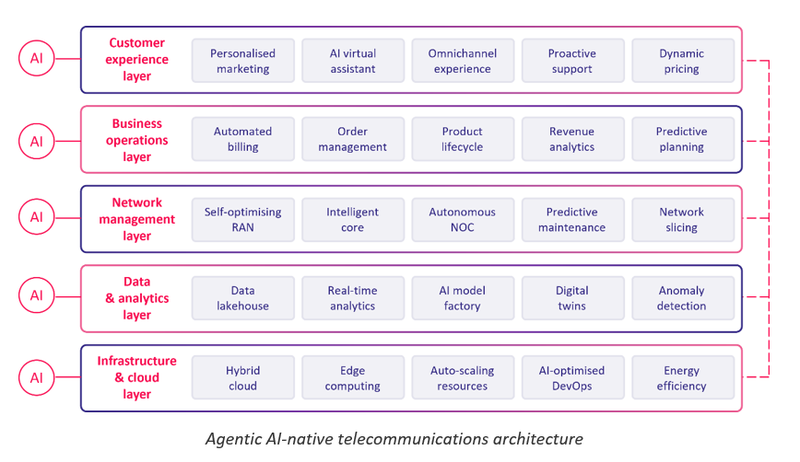
2. Achieving foundational intelligence
The journey towards an AI-native telco progresses through three distinct evolutionary stages based on how intelligence is integrated into telecommunications operations:
- Stage 1 - AI as an overlay - Telecommunications providers apply AI selectively to existing systems and processes, with AI primarily functioning as an add-on or enhancement to conventional operations. Machine learning algorithms analyse network data to identify anomalies, chatbots handle simple customer enquiries, or predictive models optimise resource allocation. However, these applications remain largely isolated, operating independently of core systems and requiring significant human oversight and intervention.
- Stage 2 - AI as an embedded component - Organisations embed AI more deeply within their technological infrastructure, integrating intelligence directly into operational systems. This enables more sophisticated capabilities like real-time network optimisation, automated trouble ticketing, and adaptive customer journeys. However, human operators still define the parameters within which AI operates, and intelligence remains confined to specific functional domains.
- Stage 3 - AI as a foundational element - AI dictates a fundamental rearchitecting of telecommunications infrastructure with intelligence as a core design principle. Network elements become self-optimising, service management becomes autonomous, and the entire organisation develops the capacity to adapt continuously to changing conditions. Intelligence permeates across traditional system boundaries, creating a unified, learning environment.
This journey mirrors the industry’s earlier shift to cloud-native architectures – only now, intelligence is the core design principle.
3. Agentic AI as a key enabler
The realisation of AI-native telco relies on the emergence of agentic AI, i.e. autonomous agents capable of managing tasks and workflows with minimal human intervention. Agentic AI possesses several transformative capabilities:
- Autonomous decision-making - Agentic AI can evaluate situations, consider multiple courses of action and implement decisions without requiring human approval for routine operations. This capability enables telecommunications providers to automate entire process chains rather than just individual steps, dramatically reducing the need for human intervention in day-to-day operations.
- Predictive intelligence - Agentic AI systems proactively anticipate potential issues, identify emerging opportunities and take pre-emptive actions. This capability transforms telecommunications operators from reactive to proactive across domains from network management to customer service.
- Contextual understanding - Agentic AI comprehends the broader context in which it operates, considering interdependencies between different systems and the implications of its actions across the telecommunications ecosystem. This holistic awareness enables more sophisticated and nuanced decision-making.
- Continuous learning - Agentic AI systems continuously refine their understanding and capabilities based on operational experience. They identify patterns, discover optimisation opportunities and improve their performance without explicit reprogramming, creating a telecommunications infrastructure that becomes more efficient and effective over time.
The deployment of agentic AI represents a fundamental shift from traditional automation, which executes predefined processes, to autonomous operation, which determines the appropriate processes dynamically based on changing conditions and goals. This effectively enables management of complexity at scale.
4. Multi-agent orchestration and collaboration
The full potential of AI-native telcos emerges from the orchestrated collaboration of multiple specialised agents across the telecommunications ecosystem:
- Hierarchical orchestration - Specialised AI agents manage specific domains (network elements, customer interactions, billing processes), while higher-level orchestration agents coordinate their activities based on broader organisational objectives. This ensures that tactical decisions align with strategic goals while maintaining operational autonomy at the appropriate level.
- Peer-to-peer collaboration - Agents operating across different functional domains communicate and coordinate directly when addressing complex issues that span traditional boundaries.
- Collective intelligence - The aggregate knowledge and capabilities of the multi-agent system exceed those of any individual agent. Insights gained in one domain inform decisions in others, creating an environment of continuous cross-functional learning and optimisation.
- Dynamic reconfiguration - The multiple agents and their relationships evolve dynamically in response to changing operational requirements. New agents can be deployed to address emerging needs, while existing agents can reorient their activities based on shifting priorities.
This distributed intelligence mirrors the shift from centralised networks to more distributed architectures that offer greater resilience and adaptability. In this way agentic AI decouples intelligence from predefined processes, enabling a more flexible and responsive telecommunications ecosystem.

 Prashant Kumar, Future Connections