Login
Register

Member Insights
As the telecoms industry shifts from rule-based automation to agentic AI, operators need to adopt a governance-first strategy for AgenticOps from the start. Omantel’s Dr. Sukrit Kalia explains.
 Sukrit Kalia, Omantel
Telecoms operators need a governance-first approach to AgenticOps
Telecoms networks have outgrown human-only operations. 5G densification, edge computing and Internet of Things (IoT) scale have pushed fault volumes and remediation windows beyond what network operations center (NOC) teams can triage manually.
In shifting from rule-based automation to agentic AI systems that reason, use tools and act with a degree of autonomy across radio access, core and transport networks, telecoms operators cannot rely on machine learning operations (MLOps) and large language model operations (LLMOps). Those approaches govern model training and inference, not autonomous, multi-agent decision chains touching live national infrastructure.
Agentic operations (AgenticOps) is the missing operational discipline, and because the stakes here are uptime service level agreements (SLAs) and regulatory exposure rather than a chatbot’s output, it needs a governance-first design from day one.
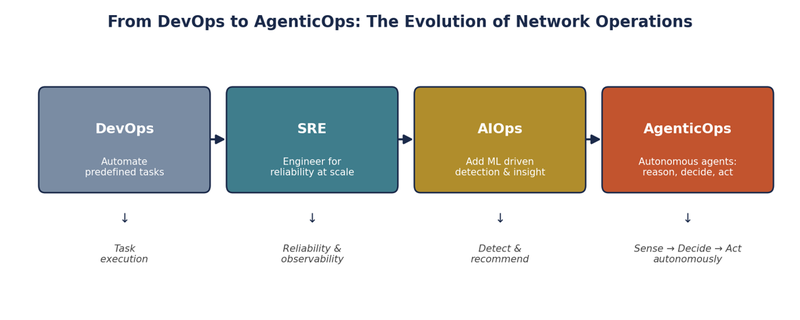
AgenticOps did not appear in isolation. It is the next step in a well-established progression of operational models. DevOps automated predefined tasks. Site reliability engineering (SRE) engineered reliability at scale. AIOps layered machine learning onto monitoring to detect and recommend. AgenticOps is the first model in this lineage where the system itself reasons, decides and acts – not merely detecting an anomaly, but diagnosing it, selecting a remediation, executing it and verifying the outcome, within the tiered autonomy and audit boundaries defined here.
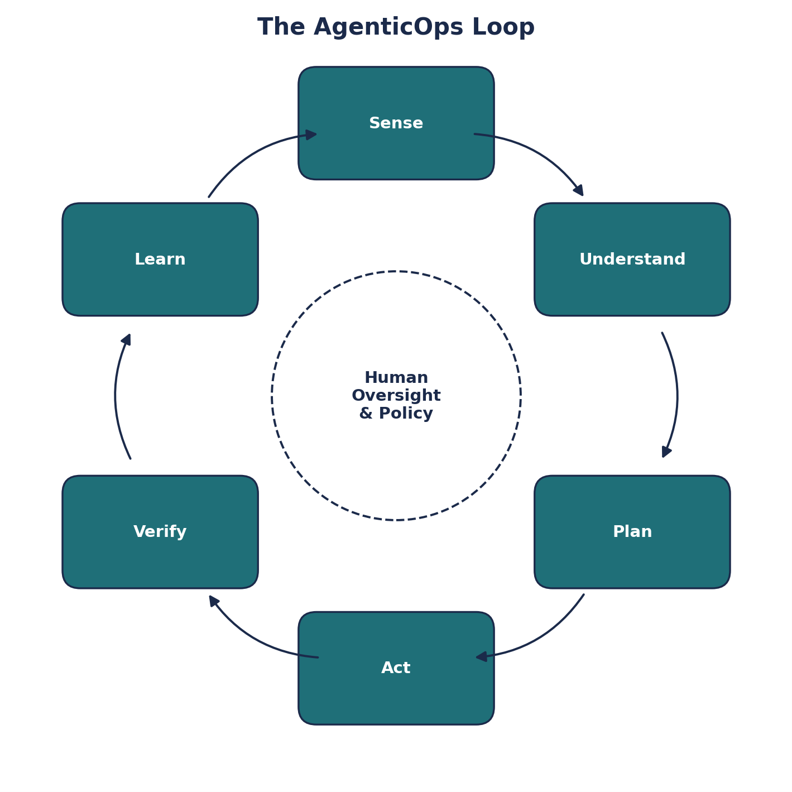
Each autonomous agent operating on the network runs a continuous operational loop – Sense, Understand, Plan, Act, Verify, Learn – with human oversight and policy positioned at the center of the cycle rather than at a single gate. This is the mechanism underlying every use case discussed here. A fault triage agent senses a degradation, understands its likely cause, plans a remediation, acts within its authorized tier, verifies the outcome against expected state and feeds the result back to improve future decisions.
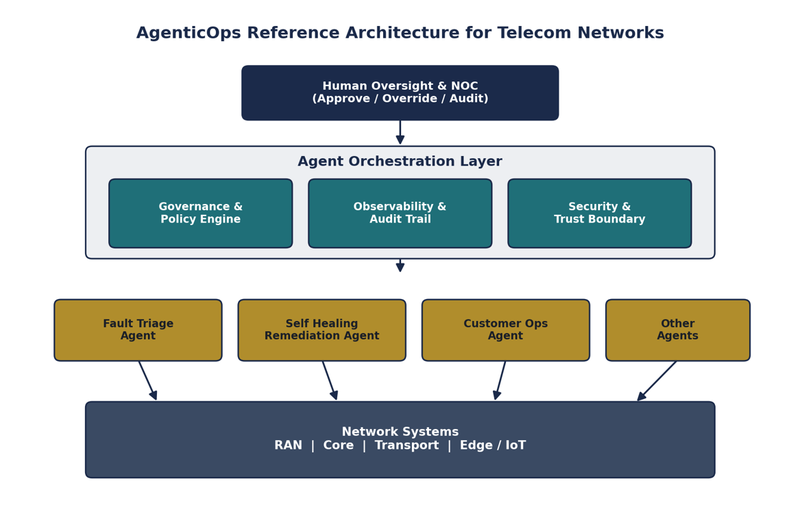
An Agent Orchestration Layer sits between autonomous agents and live network systems, enforcing policy, capturing audit trails, and mediating trust boundaries before any action reaches production infrastructure. Human oversight retains override authority at every tier.
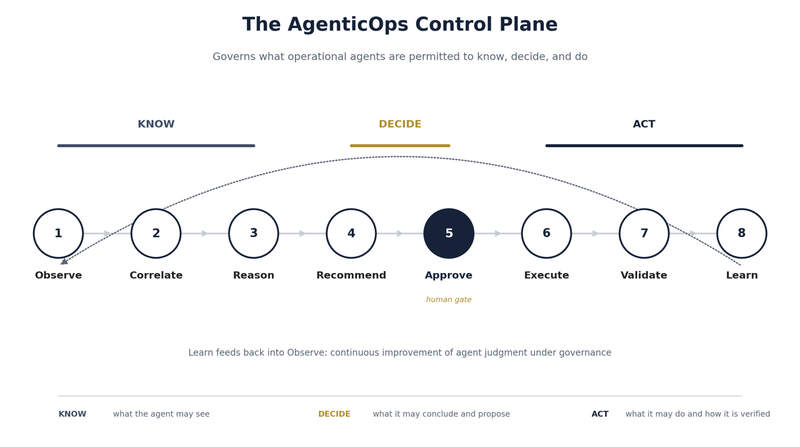
The Agent Orchestration Layer is the architecture. The Control Plane is the governance logic running inside it: the mechanism that decides at each step what an agent is permitted to know, decide and do. It formalizes the agent loop into eight governed stages:
This is the differentiator that separates AgenticOps from ungoverned automation. Autonomy is granted stage by stage, not all at once, and every stage is auditable.
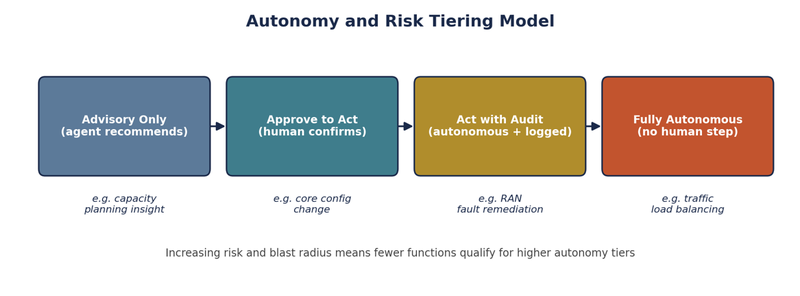
Not every network function should carry the same autonomy. A tiered model ties the degree of autonomy an agent is granted to the blast radius of its actions: advisory only for high-risk core changes or fully autonomous only for low-risk, reversible functions such as load balancing.
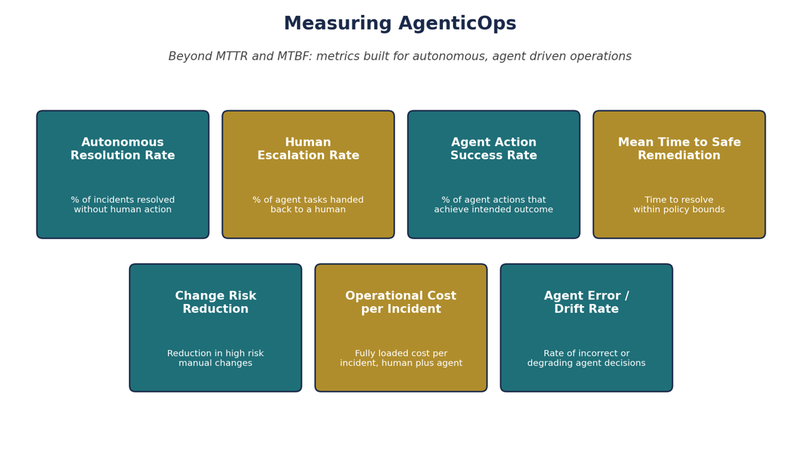
Traditional reliability metrics such as mean time to repair (MTTR) and mean time between failures (MTBF) were built for human-driven remediation and don’t capture what matters once agents are acting autonomously: how often they resolve incidents without help, how well their actions perform, and whether their judgment is improving or drifting over time. A telecom AgenticOps program should track these alongside its existing SLA metrics.
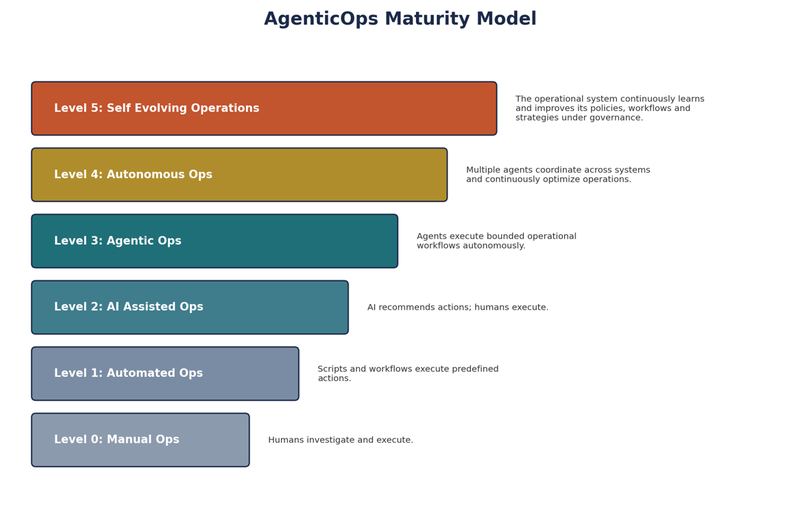
Operators do not adopt AgenticOps in a single step. The model below gives a self-assessment path from manual operations to a fully self-evolving operational system, with governance – not just autonomy – increasing at every level. Most telecom operators today sit between Level 1 and Level 2. The architecture and control plane described here are the bridge to Level 3 and beyond.
Autonomous agents are already capable of operating telecom infrastructure faster than human teams can supervise in real time. The organizations that scale this safely will be the ones that treat governance, observability, and tiered autonomy as core architecture, not compliance add ons. AgenticOps, built for the constraints of critical infrastructure, is that architecture.