Login
Register

Member Insights
Zinkworks’ Priya Saxena argues that progressing from digital models to digital shadows and digital twins gives operators the foundation for closed-loop, cross-domain network autonomy.
 Priya Saxena
Building autonomy through the digital continuum
The telecoms industry’s ambition to achieve autonomous networks is no longer aspirational; it is operationally necessary. Increasing service complexity, distributed cloud architectures, Open RAN, network slicing and growing customer expectations demand systems that can sense, decide and act with minimal human intervention.
While much attention is placed on AI and automation, sustainable autonomy requires something more foundational: a structured digital representation of the network that evolves in capability over time. This progression from digital models to digital shadows to digital twins forms what can be described as a digital continuum. It provides a practical pathway for advancing through the levels of network autonomy.
Autonomy depends on awareness. Networks cannot optimize or self-heal if they lack a coherent understanding of their own structure and behavior.
Digital models are typically the starting point. They describe topology, configurations, dependencies and service relationships. They enable simulation, planning and impact analysis before changes are deployed. At this stage, the network can be analyzed, but it is not yet dynamically aware.
Digital shadows reflect real-time operational data from the live network, performance metrics, alarms, traffic patterns and service indicators. Unlike static models, shadows provide continuous situational awareness. They consolidate cross-domain telemetry into a unified operational view, reducing siloed decision-making.
Digital twins are the most advanced state. A true digital twin not only mirrors the network but can also interact with it through bi-directional feedback. Insights generated through analytics and AI can trigger automated adjustments, enabling closed-loop control. This is where predictive intelligence begins to translate into autonomous action.
Each stage builds on the previous one. Attempting to implement autonomy without progressing through these foundational capabilities risks fragmented automation rather than systemic intelligence.
One of the core characteristics of higher levels of network autonomy is closed-loop operation where monitoring, analysis, decision and execution occur with limited human intervention.
The digital continuum provides the structural basis for these loops:
This layered approach helps operators move from reactive troubleshooting toward predictive and prescriptive operations. Instead of responding to service degradation after it affects customers, systems can identify leading indicators and take preventative action.
Importantly, this evolution aligns with the broader industry objective of progressing through defined levels of autonomy. Lower levels may rely heavily on human-driven workflows supported by analytics. Higher levels require systems capable of adaptive, policy-driven responses across domains, something that can only be achieved when data, topology and operational logic are consistently represented.
TM Forum’s TM Forum’s six-level Autonomous Network Framework explains this progression from Level 0, manual operations and maintenance, to Level 5, fully autonomous networks with closed-loop capabilities across multiple service and domains.
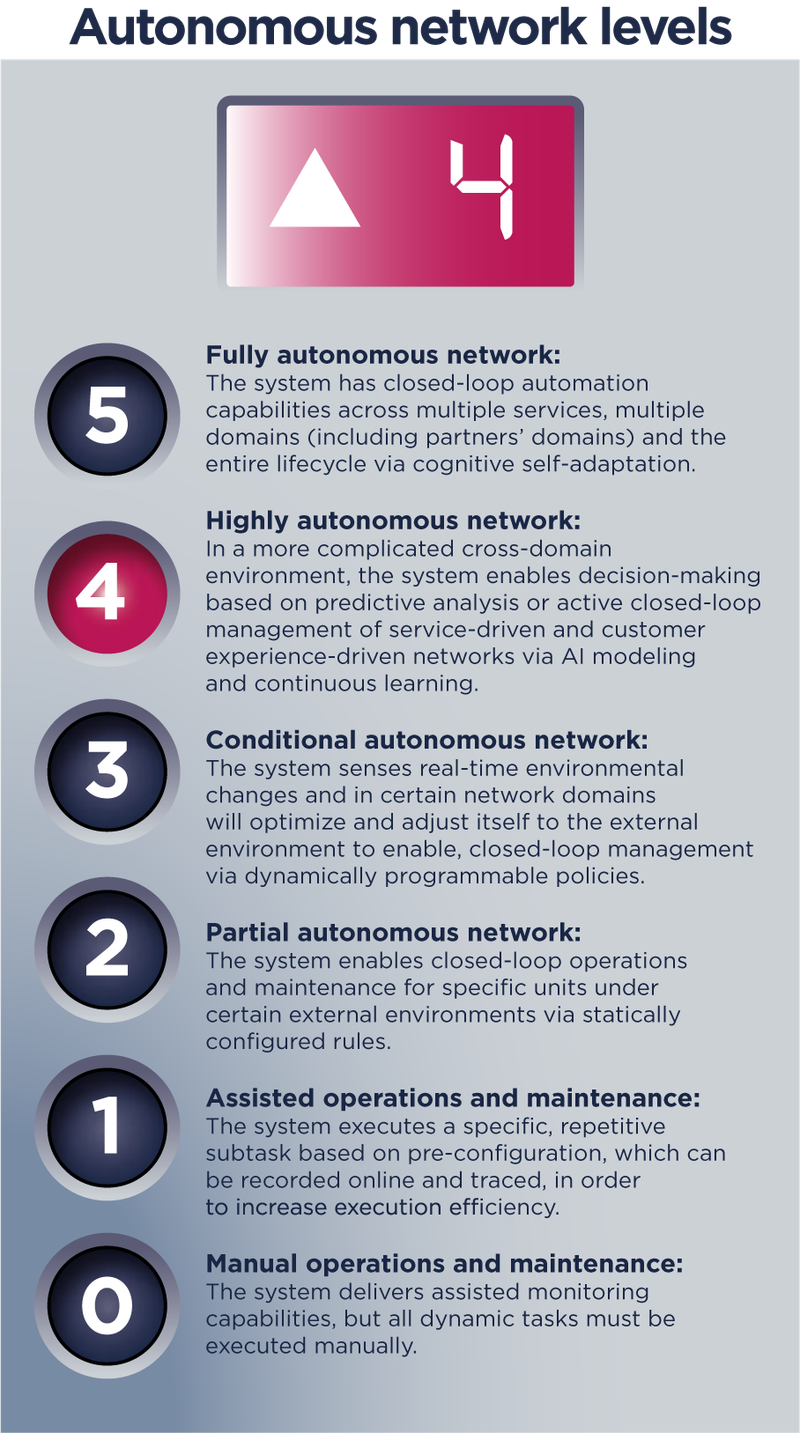
Telecoms networks today span radio access, transport and core networks, cloud infrastructure, and operational and business support (OSS/BSS) environments. Autonomy cannot be achieved within isolated domains.
The digital continuum encourages cross-domain coherence. By harmonizing data models and integrating telemetry streams, it becomes possible to understand cause-and-effect relationships that extend beyond a single network layer.
For example, a service degradation event may originate from a cloud resource constraint but manifest in RAN performance metrics. Without an integrated representation, automated remediation may target symptoms rather than root causes.
A mature digital-twin environment can incorporate these dependencies and apply AI-driven reasoning across them. This is essential for achieving self-optimization and self-healing behaviors at scale.
AI is often described as the engine of autonomy, but its effectiveness depends on the quality and structure of the digital environment in which it operates. Machine learning models require contextualized, reliable data. Decision intelligence requires clearly defined policies and guardrails.
As autonomy increases, governance becomes equally important. Trust frameworks, explainability mechanisms and policy enforcement must be embedded into closed-loop systems to ensure that automated actions align with operational and regulatory requirements.
In this sense, the digital continuum is not only a technical architecture but also a governance enabler. By maintaining traceability between models, real-time data and executed actions, operators can ensure accountability while scaling automation.
The journey toward autonomous networks does not require a single transformational leap. Instead, it benefits from incremental capabilities:
By viewing autonomy as an evolution across the digital continuum, operators can align technical investment with measurable operational maturity. The result is not simply more automation but more intelligent, resilient and adaptive networks.
As the industry advances toward higher levels of autonomy, the focus should remain clear: Autonomy is not achieved through isolated AI deployments, but through structured digital foundations that enable networks to understand, predict and optimize their own behavior.