Login
Register

Member Insights
The telecoms industry has made significant progress in automation. Now, it’s time to translate it into broader enterprise impact through cross-domain autonomy. Hakan Ekmen, CEO of P3 communications, explains.
 Hakan Ekmen
Autonomy across the enterprise is where real value lies
Over the past decade, operators have built strong capabilities in zero-touch provisioning, self-optimizing performance and closed loops within individual network domains. The next opportunity is to extend this progress into a step-change in enterprise performance. Today, efficiency is increasingly visible inside domains, but the value opportunity lies in connecting those gains across functions, handovers and decision points so that operational benefits compound across the business.
The next move for communications service providers (CSPs) is therefore not simply more automation. It is autonomy — applied consistently across the enterprise.
Automation makes a defined task faster. Autonomy changes how decisions are triggered, made and executed across functions — compressing decision cycles, reducing manual handovers and helping ensure consistent execution wherever the same action is required. One improves a step. The other strengthens the operating model.
P3’s work across telecoms and other asset-heavy industries – automotive, manufacturing, and logistics – points to the same conclusion: Autonomy creates durable value when it is embedded across the operating model rather than limited to isolated use cases. The organizations moving fastest are connecting data, decision-making and execution across operations, supply chains and customer processes – and scaling that consistently. The differentiator is not technology alone. It is consistency.
Autonomy becomes concrete when it supports core business functions and improves outcomes for customers, operations and the enterprise as a whole:
Across these areas, the pattern is consistent: Decisions and execution are connected across domains, not optimized in isolation.
AI is a central enabler of this shift, but impact comes when better decisions are executed reliably in the live environment. This is why orchestration is critical. Orchestration turns a decision into consistent action across the systems and domains it touches: automating the trigger, reducing decision latency and supporting end-to-end consistency.
Closed loops follow a disciplined path – detect, analyze, decide, act, verify, learn – with a cross-domain data and knowledge layer providing shared context for safe action. Human-in-the-loop and human-on-the-loop controls, explainability and policy guardrails keep autonomy accountable.
Autonomy is not defined by intelligence alone. It is defined by execution at scale, under control.
This is where leading operators create differentiation. The question is not only which technology is adopted, but how consistently it is embedded into a cross-domain operating model. Leaders move beyond isolated initiatives and establish aligned data, aligned processes and aligned decision-making across functions, enabling true end-to-end optimization.
The operating-model point is decisive. Autonomy is strongest when it is designed, scaled and governed as an enterprise capability. Using TM Forum’s autonomy levels (see graphic below) as a practical delivery and governance framework, most operators today are progressing through Level 2 to Level 3, with measurable value realized progressively between Level 2 and Level 4. This is a practical and achievable path: not full autonomy on day one, but consistent, governed progression.
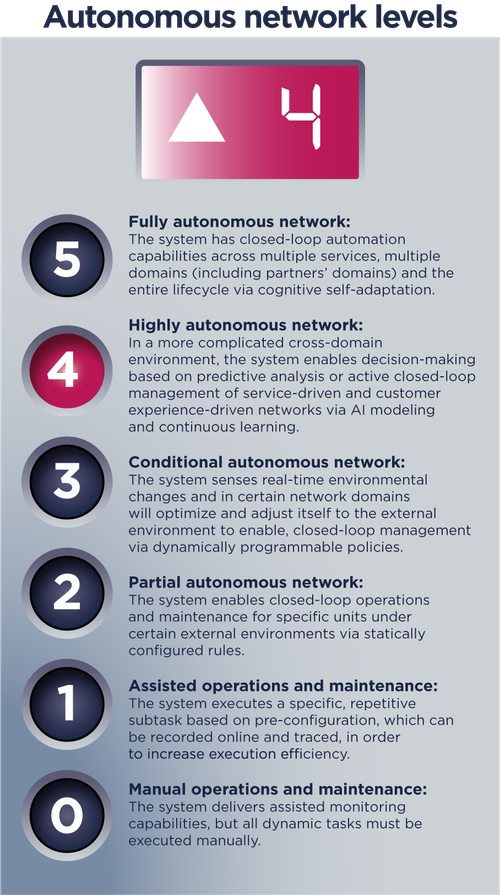
A pragmatic path is to start where the impact is highest, establish cross-domain visibility, and progressively introduce closed-loop decision-making and execution. Proving value at each step builds the operating model, data foundation, and governance needed for autonomy to scale. Over time, this creates an enterprise-wide autonomy capability rather than a portfolio of disconnected pilots.
Autonomy will be a defining factor for competitiveness in telecoms. Operators that reduce decision complexity, accelerate execution and maintain consistency across domains are positioned to achieve structurally lower cost and materially better customer experience – measured in lower opex, faster resolution and higher satisfaction.
Ultimately, autonomy is more than a network initiative. It is a way of running the business. Operators that embrace this and apply autonomy consistently across the enterprise will not only improve performance. They will help define the next phase of the industry.