Login
Register
Physical AI could transform industries and improve lives, but adoption is held back by cost, complexity and fragmented ecosystems. This Catalyst shows how CSP-enabled edge intelligence can make autonomous devices lighter, greener and commercially scalable.
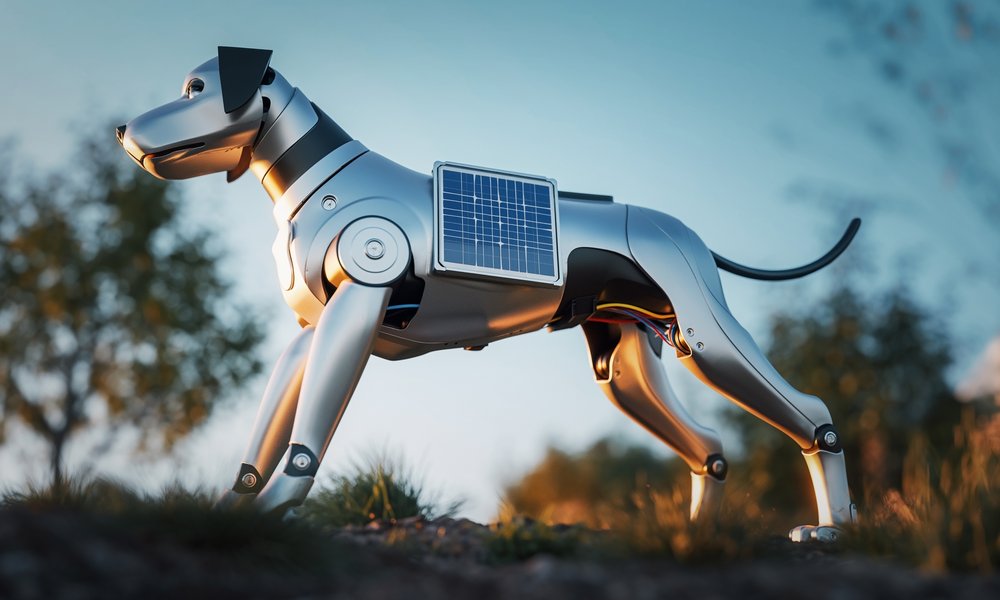
Robotic dog puts CSPs at the heart of the Physical AI economy
Physical AI, where robots, autonomous systems and intelligent devices can perceive, reason and act in the real world, is emerging as one of the next major growth areas for AI. The opportunity spans industrial automation, healthcare, mobility, personal assistance and public services, with potential to improve both commercial productivity and quality of life.
The Robotic dog: AI at the edge, sustainable revenue at scale Catalyst, showcased at DTW Ignite in June 2026, explores how communications service providers (CSPs) can accelerate this shift by moving more of the intelligence needed for Physical AI from the device to the network edge. Its flagship use case is an AI-enabled robotic guide dog designed to help visually impaired people navigate complex environments more independently, while demonstrating a reusable architecture for many other autonomous device services.
Today, many Physical AI systems are still device-centric. They rely on heavy onboard hardware for AI inference, perception and decision-making, which increases cost, power consumption and device complexity. It also locks devices into fixed compute capacity and makes it harder to adopt newer AI models as they evolve. For large-scale deployments, these constraints can slow innovation and make services difficult to update, assure and monetize.
The operational challenge is just as significant. Managing fleets of Physical AI devices across vendors, locations and service partners requires onboarding, policy control, identity management, AI lifecycle management, security, interoperability and service assurance. Without a common framework to coordinate intelligence across devices, edge infrastructure, cloud platforms and ecosystem partners, deployments risk becoming fragmented, expensive and difficult to scale.
The Catalyst introduces the AI-Native Intelligence Service Delivery Edge, or AIN-ISDE, a CSP-enabled architecture that distributes AI inference, perception fusion and complex decision-making across devices, edge and cloud. By offloading compute-intensive functions to CSP-controlled edge infrastructure, the project aims to create lighter, lower-cost and less power-hungry autonomous devices, an approach the team describes as “Green Physical AI.”
In the robotic guide dog scenario, the device communicates continuously with the edge network to support ultra-reliable, low-latency autonomous operation. The edge can process contextual information, coordinate AI models and support low-latency sensing-to-action loops, allowing the robotic dog to respond more smoothly and safely in dynamic real-world environments.
This approach also gives CSPs a more strategic role in the Physical AI value chain. Rather than providing connectivity alone, they can provide the edge and connectivity infrastructure needed to deliver real-time intelligence to Physical AI, alongside trusted communications, orchestration, AI lifecycle management and end-to-end service assurance.
For device manufacturers and service providers, this reduces the need to embed all intelligence into each device. For enterprises and public service organizations, it creates a more flexible way to deploy and manage Physical AI services across different environments and use cases.
AI-Native BSS/OSS Platform provides the monetization engine for the Catalyst, supporting unified AI and resource orchestration, partner ecosystem enablement and revenue-sharing models. This allows CSPs to package and sell AI-as-a-Service capabilities, including hosted models, lifecycle management, real-time contextual intelligence and assured network-compute services. The same architecture could be replicated across other Physical AI use cases, from industrial robotics and mobility assistants to healthcare, smart cities and public services.
The business impact is rooted in a clear shift: CSPs can evolve from connectivity providers into ecosystem orchestrators for the Physical AI era. By combining edge intelligence, AI model hosting, lifecycle management, partner enablement and assured network services, they can create new B2B2X revenue streams that go beyond bandwidth.
For Physical AI providers, the model can reduce deployment costs and accelerate innovation by shifting compute-heavy intelligence into the network. Devices can be designed with less onboard hardware and updated more easily as AI models evolve. For CSPs, the model creates opportunities to monetize distributed intelligence, AI service hosting, edge inference, contextual awareness, partner marketplaces and outcome-based service bundles.
The societal value is equally important. The robotic guide dog use case shows how connected Physical AI could improve accessibility, independence and quality of life for visually impaired people. By making assistive technologies more affordable, updatable and widely deployable, CSP-enabled edge intelligence could help bring advanced autonomy to people and communities that might otherwise be excluded by cost or complexity.
As Yue Wang, Chief Technologist at China Telecom, explains, the project positions CSPs “at the strategic heart of the Physical AI value chain, from connectivity providers to ecosystem enablers.” That positioning reflects the wider ambition of the Catalyst: to turn isolated intelligent devices into connected, AI-native ecosystem participants that can reuse shared intelligence, partner services and real-time contextual data.
The Catalyst uses a broad set of TM Forum assets to support interoperability, ecosystem coordination and AI-native service management. These include ODA, TM Forum Open APIs, eTOM and SID frameworks, IG1279 Zero-Touch Partnering Vision and Strategy, GB1027 Zero-Touch Partnering Reference Architecture, GB1032 Ecosystem Modeling Framework, GB1082 AI for BSS and Agentic AI-Native BSS, and end-to-end ODA use cases.
The team is also drawing on AI-native blueprint assets including GB1085 Model-as-a-Service, IG1251C Autonomous Networks Level 4 Target Architecture, IG1251D Autonomous Networks Agent Architecture, IG1369 GenAI Use Cases, IG1358 Intent Based Operation User Guide and the TR290 Intent Common Model family covering vocabulary, intent expression and intent reporting. Together, these assets help provide the architectural, operational and commercial foundations needed to manage Physical AI services across devices, edge, cloud and partner ecosystems.
At DTW Ignite 2026, Robotic dog: AI at the edge, sustainable revenue at scale was named winner of the Open Innovation Catalyst award for Innovative and futuristic. The project was also a finalist in the Business gamechanger category, recognizing both its forward-looking approach to Physical AI and its potential to create scalable commercial value for CSPs and ecosystem partners.