Login
Register
 Joanne Taaffe, TM Forum

Operators see sovereign AI services as strong opportunity for growth
Communications service providers (CSPs) increasingly are pointing to sovereign AI services as a path to new growth. In a recent TM Forum survey of 103 operators and B2B service providers, 55% singled out sovereign AI among the B2B products and services most likely to drive revenue growth. Only security was ahead, chosen by 61% of respondents, with network-as-a-service next on 54%.
From a telco B2B perspective, sovereign AI represents AI that the enterprise can control, govern and trust according to the laws, policies and strategic interests of the country in which it operates.
A discussion paper published by TM Forum in June 2026, for example, argues that CSPs can create a powerful role for themselves in assuring sovereignty. This would involve “operating a continuous, regulated enforcement layer that sits across every AI interaction, regardless of which models, platforms, or applications run it.”
As the builders, owners and managers of critical, regulated, national network infrastructure telcos can claim a role in helping business customers stay within the law. And regulation, certainly, is helping to shape demand for enterprise sovereign cloud and AI services. In Europe, for example, in early August the European Commission’s AI Office and national authorities began enforcing the EU AI Act.
“Sovereignty is becoming a criteria in terms of selection” for enterprises, according to Orange Business’ Julien Sicart, SVP Digital Services Business Line.
Orange Business recently adopted a new security framework, called SecNumCloud, that complies with the French government’s highest levels of governance for highly sensitive data stored in the cloud. It follows new requirements issued in France in August for governing certain cloud services used by the French State, public operators and public-interest bodies. And guaranteeing what Sicart describes as “France’s highest level of data sovereignty” will also meet growing demand from enterprise customers for sensitive data.
“Customers are moving from experiments to scale on AI, but recognizing that to pass to scale you actually need to protect the data,” says Sicart. Orange Business consulting services, for example, works with enterprises to determine where workloads and data should reside and the level of protection required, including for data in motion, depending on a given customer’s specific regulatory environment.
“Sovereignty certainly at the moment helps to get attention ... [but what matters] is the completeness of the stack that really goes from connectivity through compute to cloud into the consultancy business,” said Ferri Abolhassan, CEO T-Systems, speaking during the Capital Markets day in October.
During the event, Deutsche Telekom CEO, Timotheus Höttges, predicted the overall opportunity for the operator’s AI-related service revenues outside the US is set to exceed €1 billion by 2030, with B2B customers providing the bulk of growth: Hottges said AI enterprise service revenues outside the US will increase from an expected €250 million this year to €800 million in 2030.
In February, Deutsche Telekom launched AI Fabrik, an AI factory built with Nvidia that the operator says provides German businesses with a “complete industrial AI stack that is sovereign, secure and open”. In addition to cloud computing infrastructure located in Munich, the company offers a software and integration platform and an application layer for AI services.
“We have a partner ecosystem that goes from a Siemens to a ServiceNow, to an SAP, to Cohere. ... It's sovereign in that it is our cloud ...and it’s our telecom security ... The compute is our T-Cloud,” said Abolhassan.
This includes AI models-as-a-service (MODaaS), one of several services that can sit under the sovereign AI umbrella. AT&T, for example, offers MODaaS through its AI Gateway and Orange Business does so via Live Intelligence. It involves the delivery of AI models as an on-demand managed service, allowing customers to consume, compare and switch between models without owning or operating the models themselves. Deutsche Telekom’s focus is on offering German and European foundation models designed for vertical industrial applications.
“We have a space and a right to play for specific models and the specific needs of our industry customers,” according to Abolhassan.
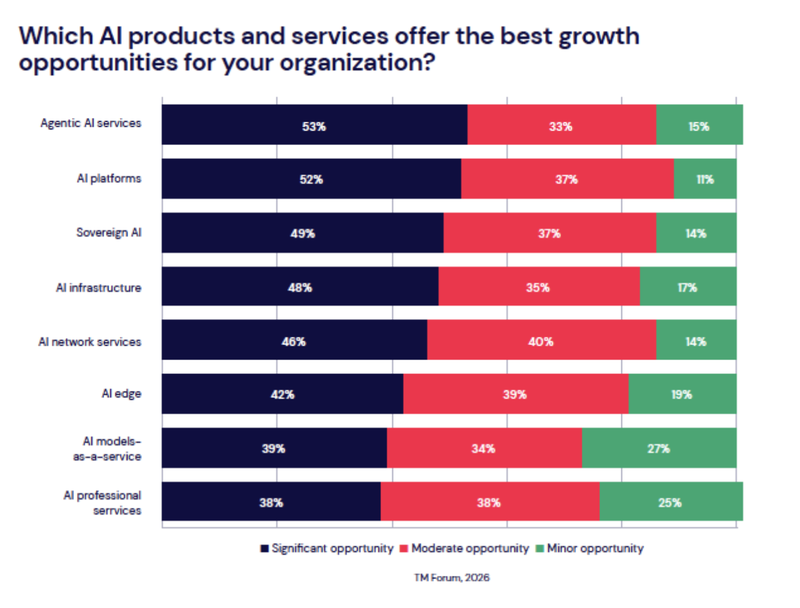
In the TM Forum survey we also asked which specific AI products and services offer the best growth opportunities for organizations. Sovereign AI came in third, chosen by 49% of respondents, with agentic AI services (53%) and AI platforms (52%) leading the way.
In addition to addressing Fortune 400 companies in sectors such as automotive, Deutsche Telekom is also targeting mid-market customers. Services include deploying agents for midsize enterprises on a multi-tenant platform, with Max Ahrens, MD T-Digital, also speaking during the Capital Markets day, adding that “mid-size customers are much more focused on a direct business outcome and not strategic benefits two or three years down the road”.
For now, Deutsche Telekom believes a full AI service stack offers the opportunity to develop new revenues without undermining other enterprise business. But it expects competition to rise.
When it comes to “the whole stack, at the moment there is not too much choice … Therefore, I would say it is not cannibalization. At the moment it develops a USP,” said Abolhassan. “Will that stay forever? Certainly no. Is it the case at the moment? Absolutely yes.”