Login
Register

Member Insights
Enghouse Networks CTO Valentin Vaduva shares how emergency response can become a repeatable model for multi-operator network orchestration.
 Valentin Vaduva, Enghouse Networks Limited

Sponsored by:

OmniBOSS Catalyst creates a pattern for multi-operator network orchestration
OmniBOSS Phase III won TM Forum’s Outstanding Catalyst — Showcase & Storyline Excellence award at DTW Ignite in June. What’s interesting about the project isn’t the award, however. It’s the pattern.
When a storm takes out several operators in a country at once, the industry’s honest answer today is 36 to 72 hours to restore service. Most of that time consists of phone calls between operators trying to agree who does what. The negotiation is the critical path.
The OmniBOSS Phase III Catalyst — championed by Safaricom and Sri Lanka Telecom, with Enghouse Networks, Esri, Mauritius Telecom and TAUSPACE as participants — models a cross-operator response based on Cyclone Ditwah, the November 2025 storm that knocked out mobile service across much of Sri Lanka.
In the Catalyst scenario, four networks lose coverage and roughly 1.1 million subscribers lose service. But the model restores 80% of coverage in 4 hours 22 minutes – an acceleration of 9x to 17x.
During the incident, the four operators’ surviving infrastructure appears as a single inventory inside each operator’s operational support system (OSS): Dialog’s intact microwave backbone, Mobitel’s west-coast cells, Hutch’s east-coast capacity and Airtel’s hill-country sites. That shared view is the primitive. With it, an AI resolver can treat what remains as one pool and plan one composed network, restoring the entire country – not four parallel restorations.
The image below shows OmniBOSS provisioning across four operators through TM Forum Open APIs.
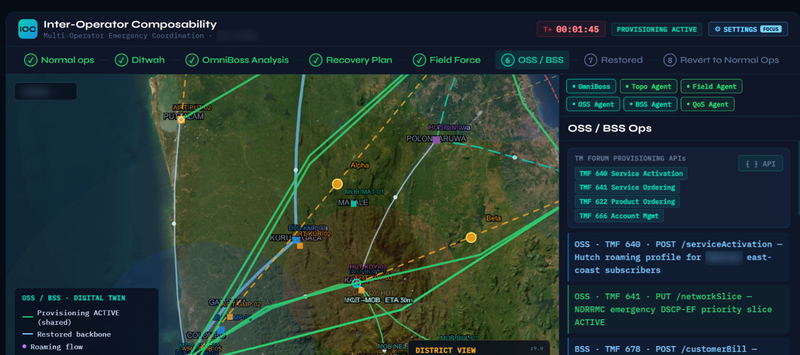
For example, a radio cell owned by Hutch could be configured to serve Mobitel customers in Batticaloa, or a fiber connection involving Dialog and Mobitel could be provisioned in Colombo. This happens through standard service-activation, ordering and inventory flows, but across the trust boundary between operators, which is something that’s rarely seen in production environments today.
The same applies in the field. In the model, 340 technicians across the four operators dispatch as one workforce to 12 cells-on-wheels (COWs), three fiber splice points and the microwave towers that need re-aiming. For the duration of the incident, the logos on the trucks don’t matter.
What makes it tractable is the catalog. The regulator orders a pre-agreed Emergency Mutual Aid product and configures it to the incident: which districts, severity tier and priority subscribers and when to wind down.
Commercial terms, activation triggers and settlement formula are approved in advance. The AI resolver scores candidate plans on coverage, priority-tier quality, settlement cost and residual risk. Then, it hands a ranked set to each operator’s orchestrator. The composition is dynamic; the authority to compose is not.
Cross-operator emergency response today has no SKU. Settlement is post-hoc, disputed and often quietly waived, and every incident is improvised from scratch. That isn’t an operational failure; it’s a market that has never been productized.
Retail subscription, wholesale roaming and number portability were each in the same state once, and each was industrialized the same way by wrapping it in a catalog, orchestrating it against standards and closing the commercial loop with auditable settlement. OmniBOSS Phase III applies that mechanism to the multilateral emergency.
Five important shifts happen as a result:
The pattern uses five mature TM Forum Open APIs — covering the catalog, order decomposition and activation, a shared event substrate and a geographic anchor — plus a sixth for multilateral settlement. All are Approved at version 4 or higher, with certified implementations in production. No protocol extensions, no new Open Digital Architecture (ODA) components.
What’s new is the convention: using these APIs in ways they weren’t written for, but fully support. The barrier to industrialization is governance, not technology.
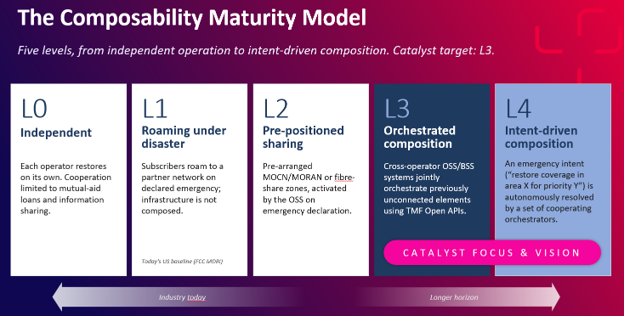
Nor is the AI a black box: its scoring is recorded for regulator review, with human-in-the-loop oversight under TM Forum’s AI Management Open APIs. The AI proposes; the orchestrators decide. Layering on intent management (TMF921) would let a regulator simply declare an outcome — restore coverage for priority subscribers in area X within four hours, under cost cap Y. That’s Level 4 on the composability maturity model; Phase III targets Level 3.
Where this goes
Nothing here is specific to Sri Lanka. The pattern works wherever there’s a multi-operator market and a regulator able to sponsor a catalog, and when the economics favor the mid-tier operators worst served by today’s bilateral arrangements.
Four non-technical conditions need to be in place, and all four are addressable within 24 to 36 months:
Emergency response is the next BSS/OSS layer to industrialize. The standards exist. What’s needed is the framework, built before the next emergency — not during it.