Login
Register
 Joanne Taaffe, TM Forum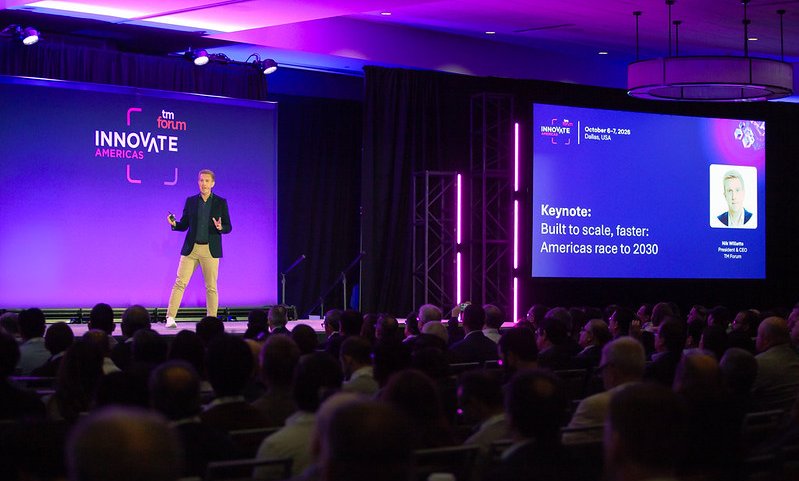
Innovate Americas: Building global standards for AI trust
“AI isn't exactly delivering the return of investment everywhere that we've expected,” said Matt Holland, Director, Data & Trust Risk Management & Assurance at TELUS, speaking at TM Forum’s Innovate Americas. “Four years into the AI revolution, we haven't made the rapid gains that we were promised.”
Holland identified trust as a primary obstacle and emphasized the importance of building trust from both a technical and people perspective. Especially in the light of growing concerns from the public and financial markets about the use of AI and what it can deliver.
“We cannot and will not be successful in this next era of technology without trust being built into the very architecture of our systems,” said Holland. “We must adopt AI in a way that is grounded in human-centric engineering. If we don't do this, we're not going to be successful. Not just as an individual organization, but as an industry.”
Telus is not alone in prioritizing trust. Telcos around the world increasingly see it as a key differentiator for the industry.
After all, “as a regulated industry providing critical national infrastructure, we have trusted presence in the markets we serve,” as Nik Willetts pointed out during his keynote address at Innovate Americas.
However, Willetts cautioned that “it's … an opportunity we're giving away at a commodity price. This has got to change.”
One way for the industry to demonstrate its trustworthiness with AI is to measure how well it governs its usage.
During Innovate Americas TM Forum announced it has partnered with Accenture to deliver a Trustworthy AI Governance Certification. An industry-standard benchmark for trusted AI, it will set out to measure governance maturity, workforce readiness and operational accountability. Its aim is to provide CSPs with verifiable evidence that agent-to-agent interactions and decisions are trustworthy and can deliver business outcomes at scale.
“It will become critical for telcos to demonstrate that they can be trusted as they move beyond experimenting with AI and delivering point value to developing autonomy that spans the business, explained Willetts.
But “if every operator and service provider tries to prove trust in their own way we're just going to create... about 1,000 islands globally of different trust models. That's not going to work for anything from regulation through to the multinational customers we're trying to service.”
TM Forum is therefore inviting its 800 member companies worldwide to participate in building the global trust standard. “We want to build something that allows operators to prove [governance], to benchmark it, to learn from each other."
Commenting on TM Forum’s move to create a global standard, Holland said, “I'll be curious to see where that lands, because for us, this is where we're seeing this starting. It requires dedicated, specialized, expertise. You need responsible AI engineers who can integrate human-centric values directly into the full engineering lifecycle.”
Having teams of engineers who understand how to build trust into the development lifecycle, working alongside internal AI policymakers, ethicists, reviewers, and testers, means that "trustworthiness then becomes a core development spec, right alongside latency, scalability, and uptime,” according to Holland.
In addition, Holland encouraged companies to prioritize data and AI literacy among all employees. At TELUS, for example, “everyone's invited to ... help break and rebuild the systems and actively participate in system design,” including employees without technical expertise.
“It captures blind spots, risks, and edge cases that even ... top-tier security dev and risk professionals might miss just due to this sheer diversity of thought," said Holland. "We're developing more trustworthy solutions because we're identifying more gaps. We're finding these risks ahead of time."