Login
Register

Member Insights
Verizon explores how creating a well-defined migration process and addressing potential challenges when managing mergers can result in improved service quality, cost savings, improved revenue and enhanced network performance with greater user experience.
 Madhava Vadavala, Verizon
 Prashant Nandkumar Pitale, Infosys
How Verizon benefited from M&A to drive transformational change
Who: Verizon & XO Communications.
What: A large-scale digital transformation to integrate XO Communication’s operations & network into the Verizon’s directional systems. This involved the migration of a substantial volume of customer data, services, and revenue to a new platform
How: A multi-phased approach that included a comprehensive Product Rationalization, Customer and Service profiles migration, and the decommissioning of all legacy XO systems to ODA compliant NorthStar Platform.
In a significant move to expand enterprise and wholesale customer base, Verizon acquired an XO Telecommunications. XO’s extensive fiber-based IP and Ethernet networks were a strategic asset, promising to not only better serve existing customers but also to help densify the Verizon’s cell network. However, this strategic acquisition came with a monumental challenge: integrating the acquired company's vast and complex operational landscape into its own streamlined, modern architecture. The objective wasn't merely to absorb the new assets but to drive a full-scale digital transformation, decommissioning redundant legacy systems and realizing the projected financial benefits, which included over $1.5 billion (NPV) in operational synergies.
Verizon acquired XO Communications in 2017 with the value of $1.8B USD, considering savings of $1.5B USD NPV through operational and expense synergies from its Enterprise, Wholesale business segments supporting Fiber based IP and Ethernet network.
The complexity of the integration was immense, encompassing more than 10K+ customers with multiple locations spread across 40+ major US markets. The core problem was the fragmentation of the US-based Telco’s IT stack, which consisted of numerous siloed applications for everything from quoting to billing. This created a significant hurdle for achieving a unified customer experience and efficient operations. The legacy stack needed to be retired, and the business had to be seamlessly migrated to the Verizon’s target systems, all while maintaining a "great customer experience."
The project was executed with a meticulous, phased approach centered around a "migration factory" model. The first and most critical step was a Product Parity Analysis. This was a painstaking exercise to understand the similarities and gaps between the legacy and target product ecosystems. The XO products/services were categorized into three groups:
This analysis was the foundation for the entire migration process, ensuring a clear roadmap for each product. Once the parity was established, the project moved to Product Enablement, which involved building the product catalog in the Verizon’s ecosystem. This was a challenging task, as the legacy products were often sold as complex "solutions" that had to be broken down and reconfigured into the new, standardized product models. For instance, the enablement of data products in the first phase involved adding many new features, while the second phase for VOIP products required the addition of complete product lines with thousands of specifications and features.
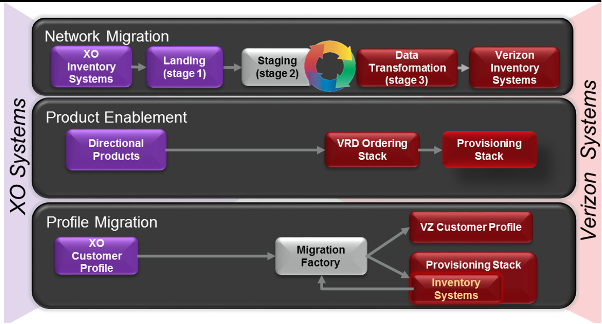
A key challenge was data mapping and integration. The project required moving data from a multitude of disparate legacy systems to a consolidated set of target applications. Verizon leveraged a state-of-the-art Informatica ETL (Extract, Transform, Load) platform to handle this massive data migration. This tool allowed the team to systematically extract data from sources like Siebel, TBS, and SingleView, transform it to fit the new schema, and enrich the data before loading it into the target systems.
The new architecture, which aligns with modern, open standards, played a crucial role. Systems like the Global Contracting Tool (GCT), Ericsson ConceptWave for quoting, and PrimeBiller for billing served as the cornerstones of the new, integrated environment. These strategic applications, many of which adhere to principles of open architectures, allowed for the seamless integration of various functional domains, from opportunity management (SFDC) to provisioning (CAMEO). This approach minimized the risk of creating new data silos and enabled the decommissioning of all XO legacy systems, resulting in substantial Opex savings.
The migration process was multi-faceted, involving distinct workstreams for different data types. Contract & Customer Profile Migration was a critical first step, moving over thousands of contracts to the new GCT platform. Pricing Migration involved creating new pricebooks and migrating thousands of services. A dedicated team focused on Service Profile Migration, ensuring that all customer service information, including ancillary services, was correctly mapped. The Inventory Management and Network Migration workstreams were tasked with loading complete XO customer profile including Services, TNs, Network Elements, application data (millions of data records) to ensure all aspects of the customer are migrated without issues.
Finally, the Self Service Portal Migration unified the user experience by migrating ~10K+ XO customers and their users to a single, integrated platform. This new portal was a single-stop shop for customers, integrating applications for user activation, reporting, and ticketing, showcasing a holistic approach to customer-facing digital transformation.
TMForum Open APIs, models like eTOM, TAM and SID and ODA framework and best practices set foundation for accelerated migration.
This project stands as a testament to the power of a well-planned digital transformation, demonstrating how a company can successfully absorb a complex acquisition, consolidate disparate systems, and achieve significant financial and operational benefits by embracing modern, open standards and architectures.