Login
Register
Japan's four telecom operators are tracing different paths. Their distinct views of what constitutes a telco provide a useful perspective on AI strategies and workforce management.
 Matt Walker, MTN Consulting LLC
 Arun Menon
What Japan reveals about AI and the telecom workforce
Across most of the world, the telecom workforce has been shrinking for more than a decade. Global operator headcount peaked at about 5.18 million in 2012 and stood at roughly 4.34 million at the end of 2025, a decline of around 16%. Between 2019, when the global headcount was 4.96 million, and 2025 the decline has been close to 12.5%. Automation and outsourcing drove much of that change. AI is now threatening to accelerate it, while also changing which roles are most affected.
Japan is an exception, and it offers a useful view of the wider trend. Its four major operators - NTT, KDDI, SoftBank and Rakuten Mobile - face the same cost pressures and technology shifts as operators elsewhere, but they have ended up in four very different positions. Comparing them tells us more than a global average does.
Three things set Japan apart. Its operators are investing heavily in data centers and AI infrastructure, not just using AI to cut costs. Employment practices at the large incumbents still favor redeployment over layoffs. And Japan is home to Rakuten Mobile which, alongside India’s Jio, is one of the few operators to have built and scaled a national greenfield network in the past decade or two.
In 2025, all four Japanese operators grew revenue faster than the global average of about 3.5%. NTT rose 3.8%, to roughly $94B, making it the world’s fifth-largest telco. SoftBank grew 9.8%, KDDI 4.9%, and Rakuten Mobile 34% from a small base. The yen was broadly flat against the dollar, so the gains were not mainly a currency effect. Japan's operators are approaching AI from a position of growth, giving them room to choose how they reshape their businesses and workforces.
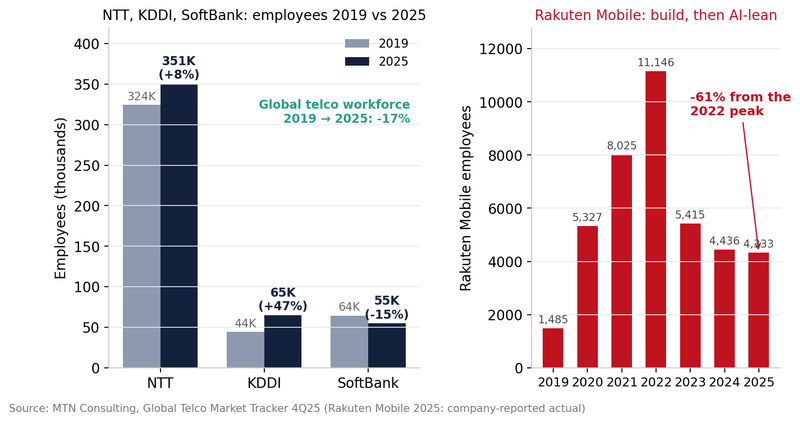
Figure 1: Employees, 2019 vs 2025 for NTT, KDDI and SoftBank, and Rakuten Mobile year by year. Source: MTN Consulting, Global Telco Market Tracker 4Q25.
Headcount is where Japan differs most sharply from the global pattern. Against a global decline of about 17% since 2019, NTT’s workforce rose roughly 8%, to around 351,000 – the second-largest telco workforce in the world, and larger than AT&T, Verizon and Vodafone combined. Much of this total sits at NTT DATA, its IT-services arm, where the work is very different from running a network. KDDI’s headcount grew about 47%, to around 65,000. But that reflects consolidation and diversification into areas such as finance, energy and its Lawson retail tie-up, rather than telecom hiring. SoftBank's telecom headcount fell about 15 percent.
Rakuten Mobile is the outlier, and the clearest example of what an AI-native operator looks like. Built greenfield, without a legacy network or workforce, it had the freedom to design a highly automated operation from the start. That is also what makes Rakuten’s model difficult for incumbents to copy. Its workforce peaked at more than 11,000 in 2022 during the network build and had fallen to 4,333 by 2025, a decline of about 61%, even as revenue rose about 70% over the same period. A cloud-native, heavily automated network needs fewer people to operate. Its investment followed the same curve: capital intensity (capex as a share of revenue) was close to 4x revenue during the 2021 build and had fallen to about 27% by 2025, moving toward the 11%-15% range that NTT and KDDI have long maintained.
Figure 2: Capex (US$B) — Rakuten Mobile year by year, and NTT, KDDI and SoftBank in 2019 versus 2025.
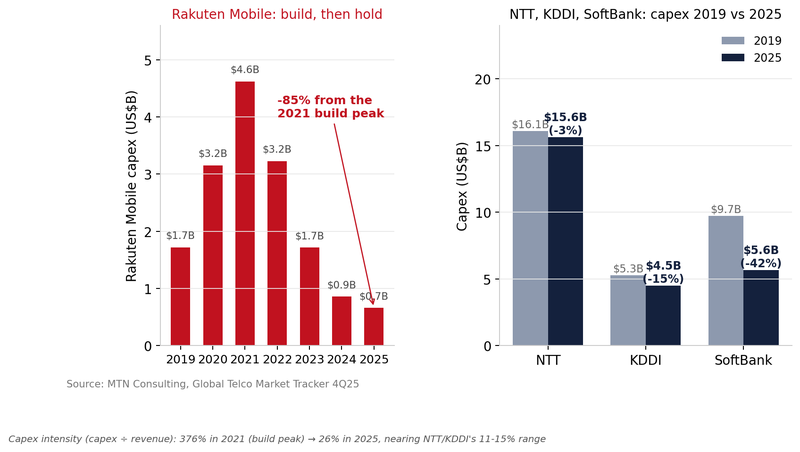
Source: MTN Consulting, Global Telco Market Tracker 4Q25
So why do the incumbents look so different? Employment norms at Japan’s large companies still favor keeping people and moving them into new roles rather than letting them go. NTT and KDDI have also expanded into IT services, finance, energy and retail, creating new areas where employees can be redeployed. Japan is not avoiding the workforce transition; it is handling more of it through redeployment than layoffs. That preserves experience and stability, but it also means cost savings come more slowly.
Their approaches to AI differ just as much, each reflecting a different view of where the returns are likely to come from.
Rakuten Mobile treats AI and automation as part of the operating model itself, rather than as a layer added on top. Software and automation reduce the need for large field and operations teams, and it now sells that architecture to other operators through Rakuten Symphony.
SoftBank sees AI as a source of new revenue, not just a way to cut costs. It is investing in data centres, GPU capacity and Stargate-linked projects, positioning itself as a supplier of AI infrastructure. It was the only one among the four whose capex increased in 2025, rising about 10.5%, against an industry trend of restraint.
NTT is pursuing a full-stack AI strategy across infrastructure and applications. Its IOWN programme aims to optimise networks and computing for AI workloads, while its tsuzumi large language model embeds AI into telecom and IT services. AI is treated as a core platform capability rather than a standalone tool.
KDDI focuses on operational AI, applying it to network management and customer operations to improve efficiency and automation. It also leverages its telecom base and adjacent businesses in finance, energy and retail to develop new AI-enabled services, combining productivity gains with selective growth opportunities.
Japan shows that AI will not produce a single workforce outcome across telecom. Rakuten Mobile built around software, cloud and automation, while NTT and KDDI are using diversification and redeployment to absorb people as they modernize. SoftBank is taking another path, moving upstream into AI infrastructure. These are not simply different AI strategies; they reflect different views of what a telco should be.
For established operators, the lesson is that AI cannot be treated as another efficiency program. Automating individual processes will have limited impact if telcos retain the same structures and layers. The bigger opportunity is to redesign how networks are built and operated, reduce manual work, and move people into higher-value activities.
In practice, however, most operators will have to get there incrementally, layering AI onto legacy systems and processes while balancing automation with the constraints of existing networks and organizations.
Ultimately, the test will be productivity, not headcount. If AI enables operators to grow revenue, network capacity and service quality without adding people, the workforce transition can be gradual. If it does not, the pressure to reduce headcount will eventually return.